
The slot burned, the doctor waited for nothing
That is how a clinics consultant describes a no-show (aznagulov.ru, 2026). There are two jobs here: do not lose the request, and return to someone who is already booked.
Когда at the start of a shift the phone, the chat and the desk all demand an answer at once, я хочу to see all requests in one place, know each patient's history and return to booked patients in time, чтобы not to waste slots in the schedule and not to answer for a message nobody checked.
We found no studies on clinics in Kazakhstan. The figures below are from other countries, except one. They show a mechanism, not your clinic’s result.
Incoming flow
Как связано с вашей задачейThese are all residents, not patients. One thing transfers: almost any patient can write in a messenger or on the site, and someone has to see that request.
Как связано с вашей задачейTurkey, a state booking system, not Kazakhstan. The mechanism is the same: booked and forgot. The most common reason: they forgot (20.7%).
Follow-up with someone already booked
Как связано с вашей задачейUS, ophthalmology, a patient portal. The mechanism transfers: a service message within a working day to someone already booked. Your channel is different, and a person sends it.
Как связано с вашей задачейA review across different countries. The mechanism transfers: a reminder inside the booking helps moderately. The number does not follow for your clinic.
Patients more often forgot than declined. A message within a working day after a no-show brought back twice as many patients as a single letter. But not everywhere: in a US pediatric pilot, SMS after a no-show did not significantly raise rescheduling (OR 1.21; P=0.38).
A reminder helps moderately: a phone reminder lowered no-shows from 16.3% to 15.8% (US), while WhatsApp in an Indian trial did not improve attendance (21.8% vs 19.6%, small sample). Wording matters: in London one wording produced 8.4% no-shows for an SMS versus 11.1% with the previous one (2015). The message is read and edited before sending.
Recording every touch
We found no figures on data quality in outpatient front-desk work, so we do not draw a card. The closest: in 12 US hospitals (2022-2023), patients with duplicate records had a higher chance of readmission (OR 1.3) and a longer stay (by 32%). This is an association in inpatient care, not a cause and not your front desk.
The conclusion is more modest: one card with the history, source and owner beats a notebook and someone’s phones.
What an owner weighs up
Calls pour in and the receptionist cannot keep up. One phone sees WhatsApp. A no-show only becomes clear when the slot is already gone.
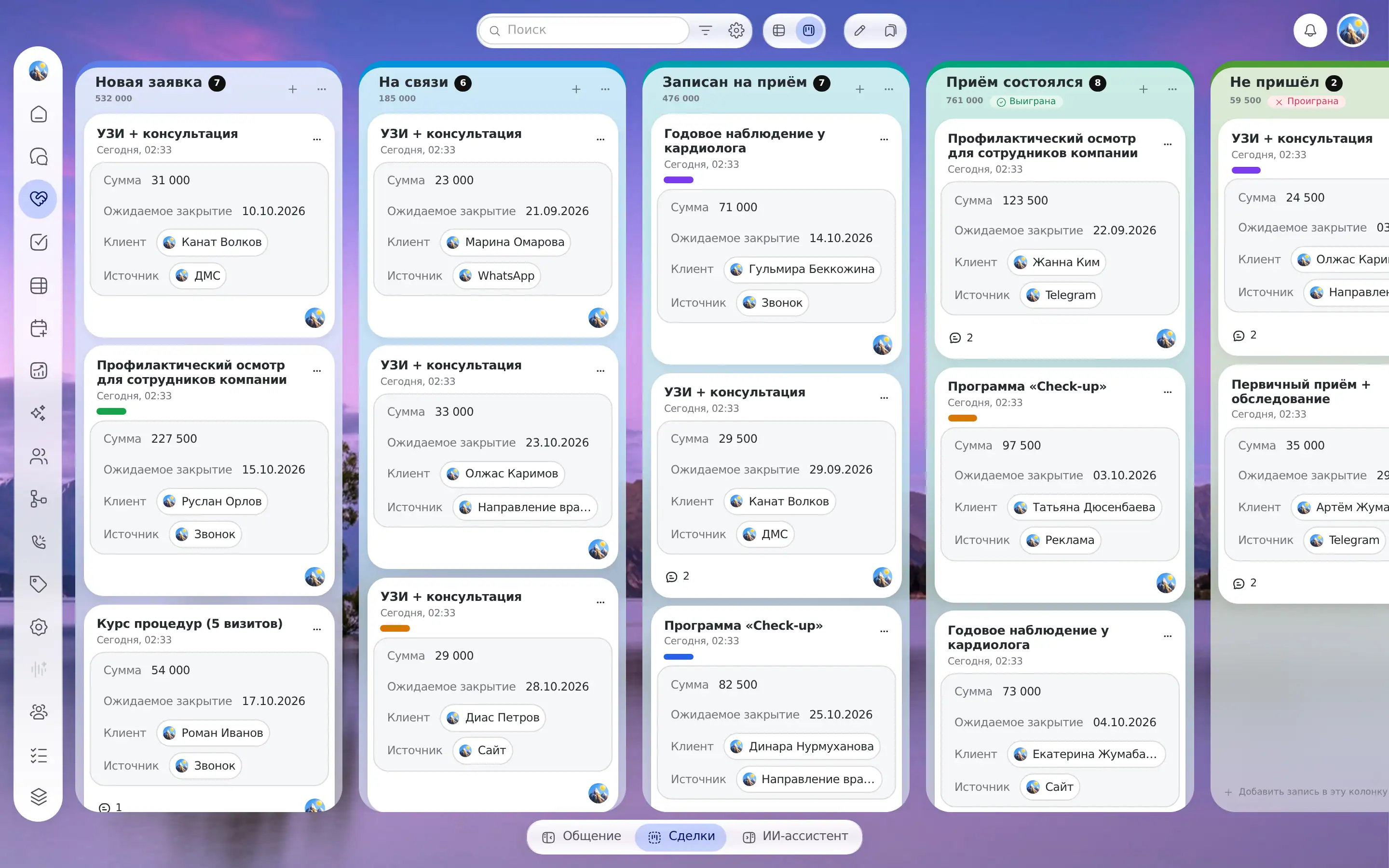
All requests on one board, each with an owner and a task. The reminder is ready: all that is left is to read and send it.
The helper will tell a patient something wrong about medicine. It is unclear what happens to the data and who answers for a mistake. The answer: the helper only prepares a draft, passes medical questions to a person, and data location is discussed before implementation.
A notebook, the administrator's personal messenger, memory. It works while the flow is small. You can start in draft mode: the helper prepares, you send.
How a single request goes through
- ВходящееA patient writes on WhatsApp in the evening
The message lands in the shared inbox, and a request and a task are created. No reply for more than an hour: escalation to the administrator.
- УчётEvery touch is recorded
The request shows the source, the owner, the chat history and the status. The log shows whether a person or the helper wrote.
- Повторное касаниеA service touch inside the booking
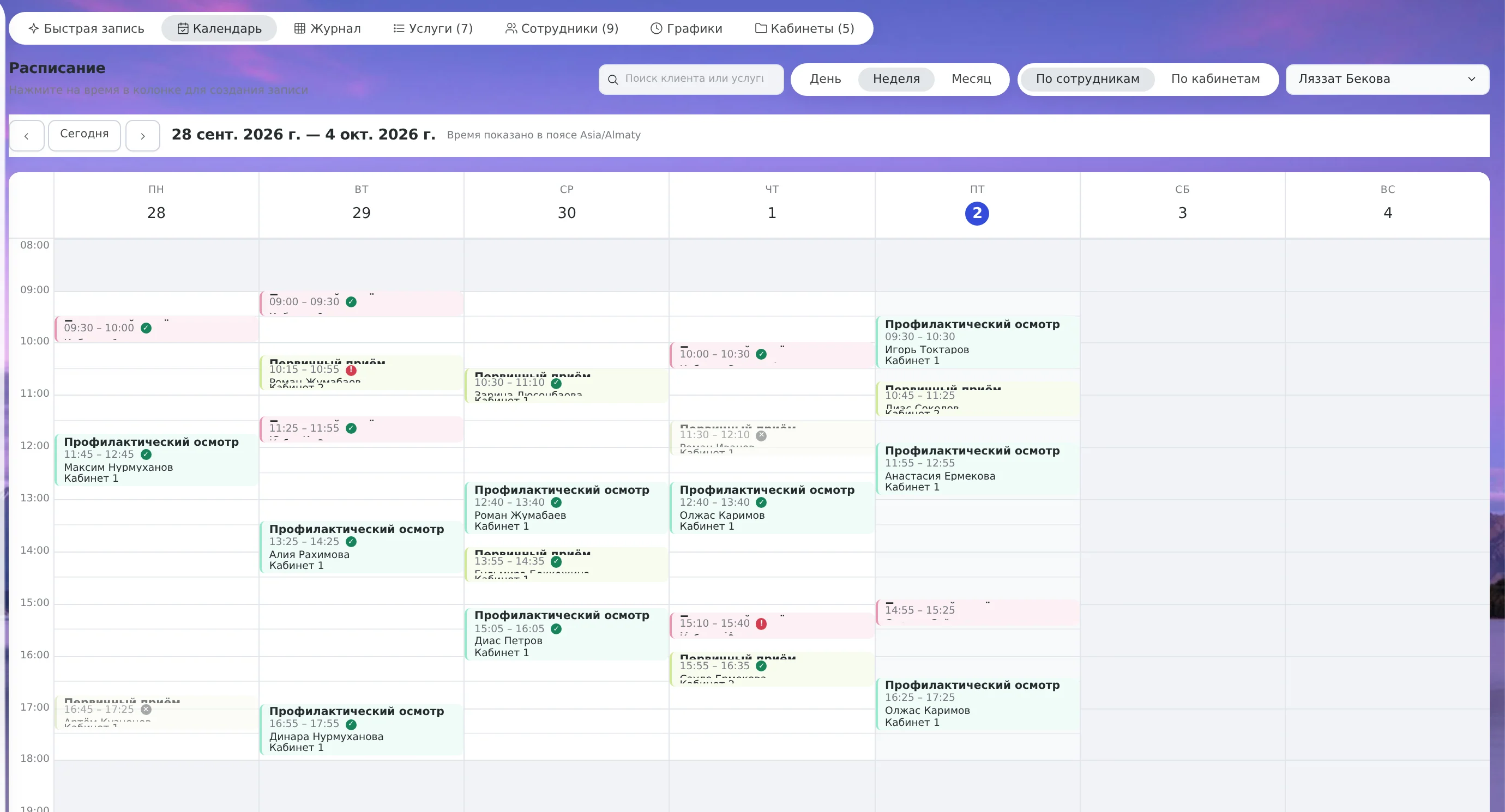
The day before the visit a reminder is ready; the administrator checks and sends it. The patient did not come: status No-show, a task to offer a new time, and an hour later a draft in the same dialog.
- ИтогThe outcome in the patient history
The visit took place, was rescheduled or did not happen: the outcome is recorded. The no-show rate is visible by the No-show status, and decisions stay with a person.
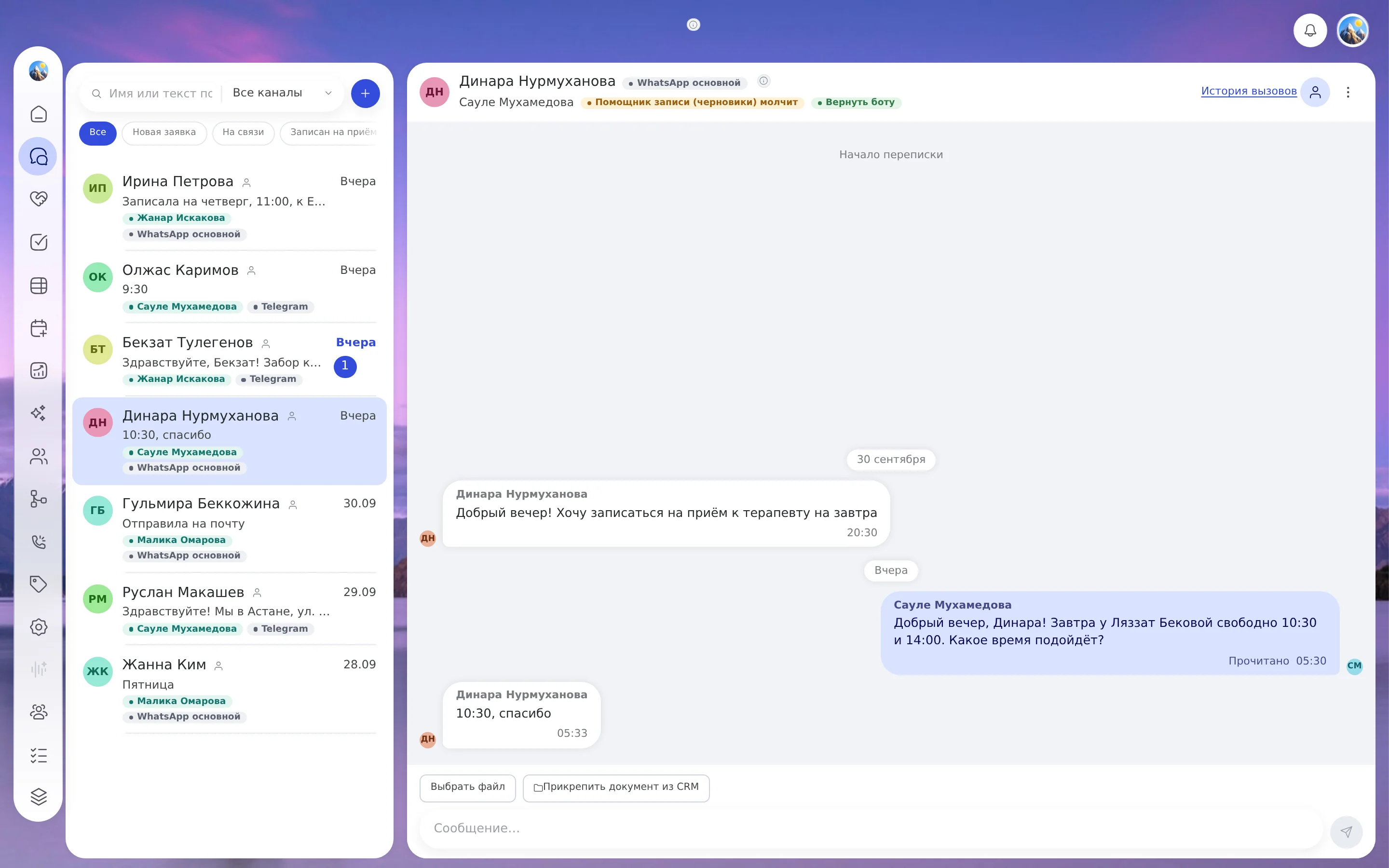
How this works in Aitomaton
Five stages: ‘New request’, ‘In touch’, ‘Booked for a visit’, then ‘Attended’ or ‘No-show’. Eight sources: website, call, WhatsApp, Telegram, doctor referral, insurance, advertising, repeat visit.
The helper prepares a draft from the clinic’s materials and the schedule, and passes a medical question to the administrator, then to the doctor. While the ‘Clinic administrator’ role has not been assigned to anyone, escalations come to the owner. After a first visit the administrator gets a question about rebooking, and two hours later a draft asking ‘any questions left?’.
Evening, WhatsApp, schedule
The example is only about the schedule. The helper does not discuss symptoms and prescriptions, and does not invent anything that is not in the clinic’s materials.
- Клиент · 20:12Good evening. I have an appointment tomorrow at 10:30. What should I bring with me?
- The clinic materials have no information on preparation: the helper does not invent an answer. A task has been created for the administrator, and no draft was sent.
- Сотрудник · 20:40Good evening! This is Aigul, the administrator. Please bring your ID. I will check the rest with the doctor and write to you today.
- КлиентCould we move it to 15:00?
- The helper does not move bookings. The reschedule request has been passed to the administrator.
- Сотрудник · 20:44I checked the schedule: 15:00 is free. I am moving it and will confirm by message.
How many slots did you lose last month?
Open the booking log: the ‘No-show’ status is counted separately in the preset. Put in your own numbers; the calculator will show the cost of empty slots and promises nothing.
What no-shows cost per month
Как считаем: visits per day × working days × no-show rate × average value. Допущение: each no-show leaves a slot empty and is not replaced by another patient; visits cancelled in advance are not counted here. Real losses are usually smaller, because some slots can be filled. Это арифметика по вашим числам, а не обещание результата.
Как цифры связаны с вашей задачей
- ЦифраInput: 93.4% of the population online (Kazakhstan, 2024)Что это значит для васPatients write in messengers and on the site, not only by phone. A request is easily lost between the phone and the desk.Что отвечает в аитоматонA shared inbox for WhatsApp and Telegram, a request with a task, escalation after an hour without a reply.ЦенностьA request no longer lives on one phone, and one left unanswered is visible.
- ЦифраLoss at the visit: 23.8% no-shows in dentistry (Turkey, 2024)Что это значит для васIn dentistry a slot goes to waste more often than in a hospital, and patients most often say the reason was forgetfulness.Что отвечает в аитоматонThe day before the visit a reminder is ready for review; the No-show status creates a task.ЦенностьThe administrator does not have to remember whom to write to. What changes in your no-show rate, your own measurement will show.
- ЦифраFollow-up: 22.2% attended after a question about rescheduling (US, 2024)Что это значит для васA message to someone booked who did not come, within a working day, brought them back more often than a single letter.Что отвечает в аитоматонAfter a no-show: a task to offer a new time, and an hour later a draft in the same dialog.ЦенностьThe patient gets a question about their booking, and a person chooses the tone and the timing.
- ЦифраFollow-up: RR 1.14 for SMS reminders (Cochrane)Что это значит для васA reminder helps moderately, and the wording affects the result.Что отвечает в аитоматонThe helper prepares a draft, and the administrator reads, edits and sends it.ЦенностьA person who read it is responsible for every message.
- ЦифраRecord-keeping: a gap in open data, closest are duplicate records in hospitals (US, 2026)Что это значит для васScattered records are linked to worse inpatient outcomes; there is no data for outpatient front-desk work.Что отвечает в аитоматонOne request with a source, an owner, the chat history and the outcome; rights and field masks by role.ЦенностьThe picture of a patient is gathered in one place.
What is already set up in the Clinic preset
The preset applies in a single action. The roles ‘Clinic administrator’ and ‘Doctor’, plus the funnel and booking dashboards, are included. Texts, services and durations are a starting point; edit them for your clinic.
Patient requests
Five stages with hints for the administrator.
Services and states
First and follow-up visits, diagnostics, procedures. States from ‘Planned’ to ‘No-show’, with example durations.
Eleven scenarios
A task to get in touch, escalation, reminders for the patient and the doctor, drafts on cancellation, no-show and after a visit.
Knowledge base switched off
Until you connect your materials, the helper does not rely on them. It does not invent prices or addresses.
Alongside an EHR, not instead of it
Kazakhstan EHR systems such as MedElement, Damumed or CRMedical keep the medical record, accounting, government systems and billing. Online booking services cover the schedule. Aitomaton does not replace them.
| Task | Where it is covered |
|---|---|
| Medical record, accounting, government systems | An EHR; Aitomaton does not do this |
| Online booking and accounting | An EHR or an online booking service |
| Shared inbox, AI drafts, tasks for the front desk | Aitomaton |
| Integration with a specific EHR | not confirmed, we do not promise it |
The table is generalized; check product features with the vendors. More: a shared inbox for messengers, AI agent in chat, online client booking.
Five steps to the first month
- Measure the baselineThe no-show rate and the number of unprocessed requests over the last month.
- Apply the Clinic presetThe funnel, roles, services and automations appear at once.
- Assign rolesAdministrators get Clinic administrator, doctors get Doctor. Check that a doctor sees nothing extra.
- Connect WhatsApp and TelegramCheck the helper drafts on real messages while it works in draft mode.
- Compare after a monthThe no-show rate and first-response time against your baseline; decide what to change.
Who decides what, and where the data lives
You carry the risk of an error, so the boundary is drawn in advance. Administrative work (schedule, prices from your materials, preparation for a visit) is prepared by the helper. Clinical work (symptoms, diagnoses, prescriptions, tests) is decided by a person only.
The preset agent can see and edit a client’s name but not deal amounts; it does not create, move or cancel bookings; it does not move or close deals. Its answers are signed by an official persona, and the log shows whether an agent or a colleague wrote.
Rights are enforced by the platform core, not the interface: tables and fields a role does not have are absent from its output and are not readable even by a direct request.
Patients’ personal data. The Law of the Republic of Kazakhstan No. 94-V of 21.05.2013 ‘On Personal Data and its Protection’: processing proceeds with the subject’s consent (Article 7, paragraph 1), and storage is in a database on the territory of Kazakhstan (Article 12, paragraph 2). For medical data, the Minister of Health order No. 88 of 5 August 2026, in the version effective from 23 August 2026, according to the zakon.kz publication, requires servers physically in Kazakhstan. The clinic remains the controller. We do not claim certifications or data locations that are not in the platform documents; the tariffs include an on-premise option with individual terms. Before implementation, check consent, the contract and the location with a lawyer.
The company has an internal policy on requests from state bodies: written requests only, a legality check, and the minimum scope of disclosure.